
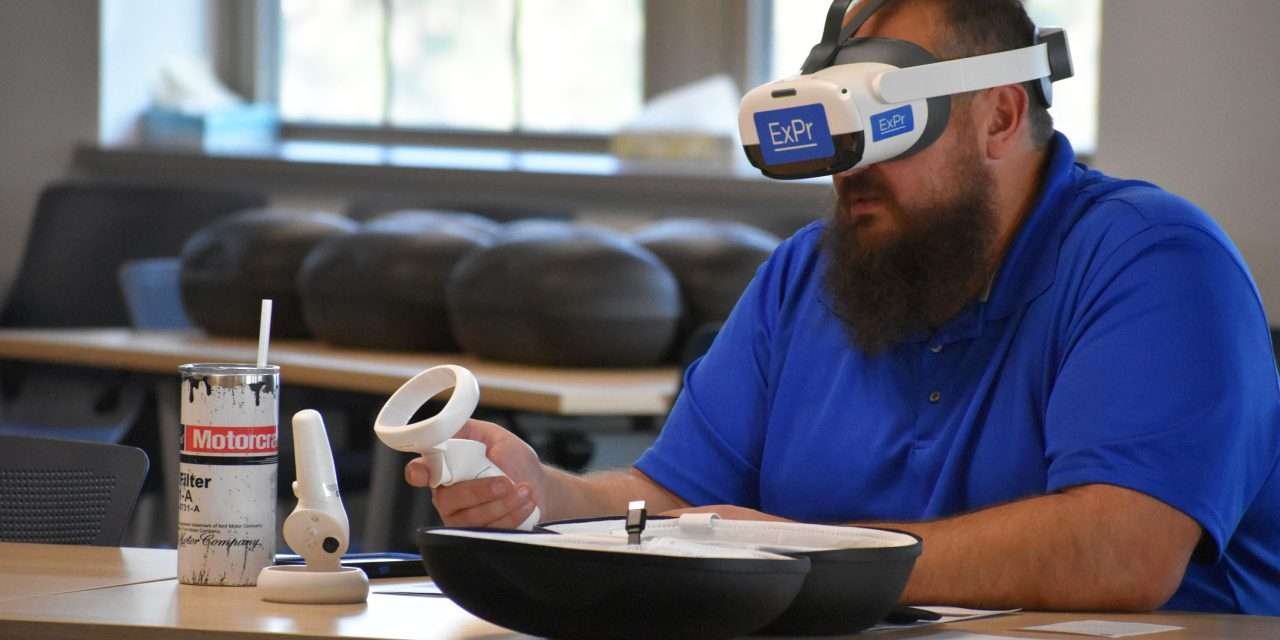
The Expertise Project and the Herkimer-Fulton-Hamilton-Otsego BOCES School to Careers program recently gathered local teachers to provide them with virtual reality headsets and show them how Expertise Project VR experiences can expose students to career opportunities.
“This is a way for them to take virtual field trips to local businesses for career exploration,” Herkimer BOCES School to Careers Liaison Sarah Crowe said. “And they don’t even have to leave the classroom.”
Teachers from Herkimer BOCES programs and from school districts in the Herkimer County and Herkimer BOCES region attended the event on Friday, Nov. 20, at the Herkimer BOCES Gateway Center in Herkimer to receive the headsets and training in using them. Mike Baron, Dan O’Sullivan and Hailee Riggi from the Expertise Project presented to teachers and showed them how to use the equipment.
The Expertise Project has 30 VR headsets for the Herkimer BOCES region, and through a two-year grant, local schools have free access to the headsets, Expertise Project VR videos and accompanying lessons for students.
It’s great to get the technology into the hands of local teachers who will put it to use and help students connect to careers, Herkimer BOCES School to Careers Coordinator and Work-Based Learning Coordinator MaryBeth Napolitano said. The VR field trips eliminate transportation costs, while still connecting students to local careers and getting students excited about their learning, she said.
“With these headsets, we can bring relevant places within New York state into the classroom,” Napolitano said. “The Expertise Project is also taking it a step further because they have made relevant lessons for each of the field trips.”
Baron, who is president and co-founder of the Expertise Project, explained to teachers that there are three main aspects of what they offer: Workforce Web, labs and projects.
Workforce Web features three-minute videos at local businesses and construction sites to allow students to virtually visit the locations for career exploration and discussion. Students can then be asked if they’re curious to know more about the career they explored. They might say “no” to most, but it increases their awareness of opportunities and could help them find an area they’re interested in, Baron said.
“Then, when you have that awareness base, you can take them anywhere,” Baron said.
The labs are longer VR videos and include lesson plans. There also is an opportunity to do capstone projects by visiting sites in-person and helping the Expertise Project record VR videos – which the Herkimer BOCES READiTEC program did.
O’Sullivan, partner and co-founder of the Expertise Project, said the VR experiences show students what they don’t know.
“It should spark curiosity, but besides sparking curiosity, it should satisfy some of that curiosity,” O’Sullivan said.
The experiences allow students to find out more about career options, see what the jobsite looks like, view the work that’s done by people in that career and discover how their academics can connect to those jobs – such as eighth grade algebra and geometry connecting to blueprints and engineering jobs.
There’s another reason the Expertise Project does what it does in addition to wanting to help students find careers they’re interested in, O’Sullivan said. It’s because workforce development is part of economic development for a region, and that workforce development starts in schools.
Riggi went through the Expertise Project program in school, and it changed her plan from going to school for pre-med when she found out that medical engineering existed. She now has a biomedical engineering degree and does backend research and development for medicines in her job as a research engineer for Regeneron Pharmaceuticals – in addition to working with the Expertise Project.
“I’m doing exactly what I wanted to do in a way I had no idea I could,” Riggi said.
Discover more from The Daily Post
Subscribe to get the latest posts sent to your email.
