
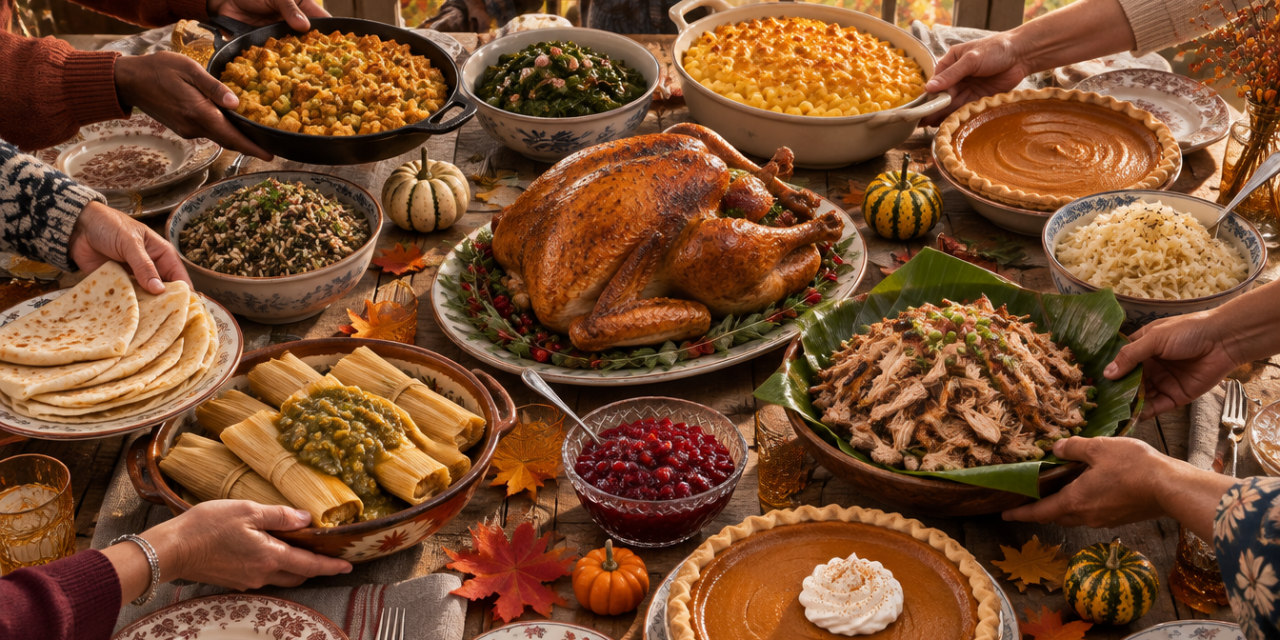
From turkey trots and fried birds to a Pacific island that borrowed the holiday from Yankee whalers, Thanksgiving looks different depending on where you pull up a chair.
Thanksgiving arrives Thursday, November 26, and while the basic script is familiar (family, food, football, a nap), the details change a lot from one kitchen to the next.
Ask ten households what “real” Thanksgiving dinner looks like and you will get ten different answers, most of them delivered with great conviction.
A nation on the move
For millions, the holiday starts on the road. AAA projects 81.5 million Americans will travel at least 50 miles from home between Tuesday, Nov. 24, and Monday, Nov. 30.
That is a hair below last year’s 81.6 million and ends a three-year streak of record Thanksgiving travel.
Driving still dominates, with about 72.9 million people expected to make the trip by car and roughly 5.96 million taking domestic flights.
Once they get there, the meal will cost a little more. The American Farm Bureau Federation’s 41st annual survey puts a classic dinner for 10 at $58.63, up 6% from 2025, though still below the 2022 record of $64.05.
The turkey drove most of the increase: a 16-pound bird averaged $23.68 this year.
The same bird, a different table
The turkey may be universal, but what surrounds it is deeply regional.
The South leans on cornbread dressing (never “stuffing”), sweet potato casserole or sweet potato pie, collard greens and macaroni and cheese baked firm enough to slice.
The deep-fried turkey, once a Cajun backyard specialty, has spread nationwide, along with the annual fire department warnings that come with it.
In Louisiana, the table may also hold gumbo or a turducken, a deboned turkey stuffed with a duck stuffed with a chicken.
New England, which claims the holiday’s origin story, still favors the traditional: roast turkey, bread stuffing seasoned with sage, cranberry sauce, squash and pies made with apples and pumpkins.
Along the coast, oyster stuffing remains a family heirloom recipe in many homes.
Baltimore and parts of Maryland carry one of the more surprising customs: sauerkraut served right alongside the turkey, a holdover from the region’s German immigrant communities.
In Pennsylvania Dutch country, look for potato filling, a rich mix of mashed potatoes and bread stuffing.
The Upper Midwest brings wild rice dishes, and in Minnesota and the Dakotas, Scandinavian families often set out lefse, a soft potato flatbread. Green bean casserole and the occasional Jell-O salad hold their ground here with pride.
The Southwest adds heat. Tamales, green chile stuffing and chile-rubbed turkey are common in New Mexico, Arizona and Texas, where Mexican and Indigenous traditions blend with the Pilgrim menu.
Hawaii may have the most distinctive version of all: kalua turkey, slow-cooked in an underground imu oven the way kalua pig is prepared for a luau, often served next to rice, poi or sweet potatoes.
Rituals beyond the plate
Thanksgiving morning belongs to the Macy’s Thanksgiving Day Parade, and this year is a big one. The 100th parade steps off in Manhattan with a record-breaking 100-plus balloons and inflatables.
New characters include Bluey, Hello Kitty, Joe Cool and Woodstock, Underdog and a Sorcerer’s Apprentice Mickey, with performers including Megan Moroney, Teddy Swims and Queen Latifah.
Afternoons belong to football. The Detroit Lions and Dallas Cowboys host their traditional Thanksgiving games, and both cities rank among AAA’s top holiday destinations because of it.
Before the eating starts, many Americans run. Turkey trots now fill the calendar in towns of every size, including Little Falls, and New York can claim the granddaddy of them all: the YMCA Turkey Trot in Buffalo, held since 1896 and recognized as the oldest continuously run footrace in North America.
Other customs keep growing. “Friendsgiving,” a gathering of friends rather than family, has become a fixture for younger adults and people who can’t travel home.
Volunteering at food pantries and community dinners is a tradition in its own right. And the White House turkey pardon, lighthearted as it is, remains a reliable bit of holiday theater.
Does anyone else do this?
Thanksgiving is often called the most American of holidays, but the United States is not alone in setting aside a day for gratitude.
Canada celebrates on the second Monday of October (Oct. 12 this year). The meal looks familiar, with turkey, stuffing and pumpkin pie, but the earlier date reflects a shorter northern harvest season, and the holiday carries less of the Pilgrim story.
Liberia, founded in part by formerly enslaved Americans, marks Thanksgiving on the first Thursday of November. Tables there are more likely to hold spicy roast chicken and mashed cassava than turkey, with church services, live music and dancing.
Norfolk Island, a tiny Australian territory in the South Pacific, observes Thanksgiving on the last Wednesday of November. The custom dates to the 1800s, when American whalers stopped there; a trader named Isaac Robinson reportedly decorated the local church with palm leaves and lemons to draw them to a Thanksgiving service.
Islanders still bring fruits and vegetables to church that day.
Grenada holds its Thanksgiving on October 25, commemorating the 1983 U.S.-led intervention that followed a violent coup. It is a day of formal ceremonies and remembrance, not feasting.
Japan observes Labor Thanksgiving Day (Kinro Kansha no Hi) every November 23. Its roots reach back centuries to an imperial rice-harvest rite, but since 1948 it has honored workers. Schoolchildren often make thank-you cards for police officers, firefighters and other public servants.
Germany, Austria and Switzerland celebrate Erntedankfest, a church harvest festival usually held in early October, with altars decorated in produce and processions in some villages. Geese and chickens are more common than turkey.
And in Leiden, the Netherlands, where many of the Pilgrims lived before sailing to America, residents gather on the fourth Thursday of November for a nondenominational service at the centuries-old Pieterskerk, followed by coffee and cookies.
The common thread
Whether the bird is roasted, fried or buried in a pit, and whether the day falls in October or November, the idea underneath stays the same: stop, gather and say thanks.
However your family does it, the real tradition is showing up at the table.
Discover more from The Daily Post
Subscribe to get the latest posts sent to your email.
