
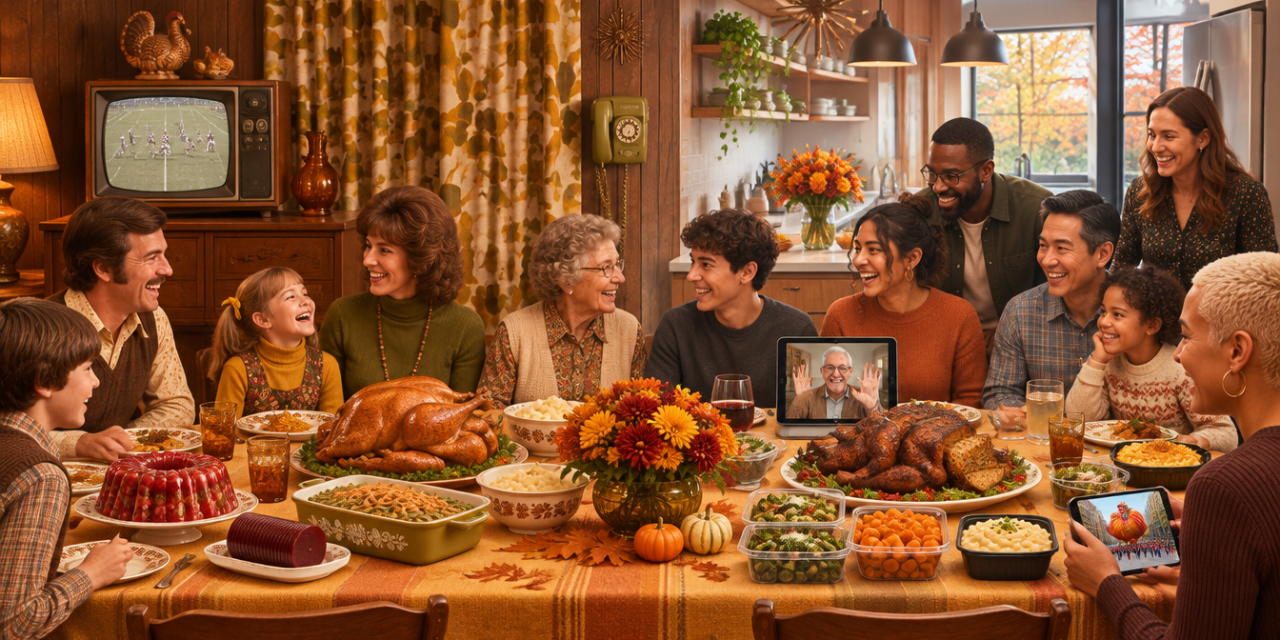
The turkey is still in the middle of the table. Nearly everything around it has changed since 1976.
Picture Thanksgiving 1976. The country was in the middle of its Bicentennial year. Dinner came out of a kitchen with avocado-green appliances, cranberry sauce slid out of the can with its ridges intact, and the TV in the living room carried one parade and two football games.
Stores were closed. Long-distance calls to relatives who couldn’t make it home were short, because they were expensive.
Fifty years later, the holiday still has the same bones: food, family, football and a parade. But how Americans cook, shop, watch and gather on the fourth Thursday of November has shifted in ways that would surprise the family at that 1976 table.
The table: from Jell-O molds to brined birds
The 1970s Thanksgiving menu came largely from the can and the box. Campbell’s green bean casserole, invented in the company’s test kitchen in 1955, was already a fixture.
So were molded gelatin salads, boxed stuffing mixes, canned yams topped with marshmallows and the jellied cranberry log.
Many of those dishes survive, often out of pure nostalgia, but the cooking around them has changed.
Starting in the 1990s, food magazines and TV cooks popularized brining the turkey for juicier meat. The deep fryer spread from Cajun backyards across the country. Smoking, spatchcocking and dry-brining followed.
Food TV and, later, social media turned the meal into something to plan, photograph and share.
The guest list for the menu grew, too. Tofurky, the plant-based roast, came out in 1995, and today many hosts plan for vegetarian, vegan or gluten-free guests as a matter of course.
Others skip cooking altogether, ordering a complete dinner from the grocery store, a restaurant or a meal kit company.
The price has changed less than you might think. The American Farm Bureau Federation began its annual Thanksgiving dinner survey in 1986, when a classic meal for 10 cost $28.74. This year it is $58.63. That sounds like a big jump, but prices overall have risen faster.
By one analysis, the meal actually got cheaper in inflation-adjusted terms between 1986 and 2020.
The bigger swings have come recently: the survey hit a record $64.05 in 2022, dropped for three straight years and is now rising again on higher turkey and diesel costs.
Black Friday swallows the weekend, then gives some back
In the 1970s, Black Friday was mainly a nickname used by retailers and police for the chaotic shopping day after the holiday. Over the following decades it became a national event, with stores opening earlier each year: 6 a.m., then 4 a.m., then midnight.
By the 2010s, many big chains were opening on Thanksgiving evening itself, and the holiday dinner started competing with doorbuster sales. Then the trend reversed.
Since the pandemic year of 2020, Target, Walmart, Best Buy, Kohl’s and many others have stayed closed on Thanksgiving Day, and Walmart’s U.S. chief has called Thanksgiving openings “a thing of the past.”
In a few New England states, including Maine, Massachusetts and Rhode Island, state law keeps most stores closed anyway.
The shopping didn’t go away; it moved online and got longer.
Cyber Monday arrived in the mid-2000s, “Giving Tuesday” and “Travel Tuesday” followed, and retailers now push Black Friday deals as early as late October.
Who sits at the table
The 1976 Thanksgiving was largely a family affair, often hosted by the same relative every year. Today the guest list looks different for many households.
The most visible change has a name: Friendsgiving. The idea of a holiday meal with friends is not new (Peanuts fans will remember Charlie Brown’s improvised feast of toast, popcorn and jellybeans in 1973), but the word is.
Merriam-Webster traces its first known use to 2007. A 2011 liqueur ad campaign helped spread it, and the dictionary added it in 2020.
For many younger adults, Friendsgiving is now a second celebration on top of the family dinner, not a replacement for it.
Families themselves have changed shape. Blended families split the holiday between households, sometimes eating two dinners in one day.
Adult children live farther from home. And since 2020, relatives who can’t travel are often at the table anyway, on a phone or tablet propped against the gravy boat.
Travel has grown along with all of this. AAA expects 81.5 million Americans to travel at least 50 miles for Thanksgiving this year, the vast majority by car, after three straight record years.
The TV and the game
Television has been part of Thanksgiving for generations, but the lineup has grown.
The Macy’s Thanksgiving Day Parade began in 1924 as a store promotion and became a national TV tradition after World War II. This year’s 100th parade will be carried on broadcast TV and streamed online, so viewers can watch it on a phone in the car on the way to Grandma’s.
Football has expanded even more. The Detroit Lions have hosted a Thanksgiving game since 1934, and the Dallas Cowboys joined in 1966, which means the 1976 family had two NFL games to choose from.
In 2006, the league added a third game in prime time, first on the NFL Network and later on NBC. In 2023, the NFL added a Black Friday game, too.
Thanksgiving football now runs from lunch until bedtime, and halftime shows have become major entertainment events of their own.
Then and now, close to home
Some questions for our readers to answer here, or on Facebook:
- What did Thanksgiving dinner look like at your house in the 1970s? Who hosted?
- What dish has survived from then to now, and what disappeared?
- How far did family travel then, compared to today?
- Did anyone shop on Thanksgiving weekend back then? What about now?
- What’s one tradition you hope never changes?
What stayed the same
For all the changes, the core of the day would be recognizable to the 1976 family. There is still a turkey, still pie, still an argument over football and still someone asleep on the couch by 4 p.m.
The menu, the guest list and the screens have changed. The reason for gathering hasn’t.
Discover more from The Daily Post
Subscribe to get the latest posts sent to your email.
